The Apostle Paul teaches in Colossians 1:16–17 that Jesus is the eternal God and the Creator of all things. Although Jehovah’s Witnesses do not believe that Jesus is the eternal God and Creator of all things, they acknowledge in their own commentary that, grammatically, the Greek New Testament presents Jesus as the eternal Son of God through whom all things came into existence.
JW’s Text and Commentary on the passage:
16 because by means of him all other things1 were created in the heavens and on the earth, the things visible and the things invisible, whether they are thrones or lordships or governments or authorities. All other things2 have been created through him and for him. 17 Also, he is before all other things, and by means of him all other things were made to exist
- by means of him all other things were created: God used “his beloved Son” (Col 1:13) in creating the things “in the heavens and on the earth, the things visible and the things invisible.” This would include the millions of other spirit sons in Jehovah God’s heavenly family, as well as the physical universe. (Ge 1:1; Da 7:9, 10; Joh 1:3; Re 5:11) Jesus was Jehovah’s firstborn Son and the only one created directly by God. (Heb 1:6; see study notes on Joh 1:14 and Col 1:15.) Logically, it was to this firstborn Son that Jehovah said: “Let us make man in our image, according to our likeness.”—Ge 1:26.
- all other things: A literal rendering of the Greek text would be “all things.” (Compare Kingdom Interlinear.) However, such a rendering could give the impression that Jesus was not created but was the Creator himself. And that idea would not agree with the rest of the Bible, including the preceding verse, which calls Jesus “the firstborn of all creation.” (Col 1:15; compare Re 3:14, where Jesus is called “the beginning of the creation by God.”) Also, the Greek word for “all” can in some contexts have the meaning “all other,” as for example at Lu 13:2 (“all other”); Lu 21:29 (“all the other”); Php 2:21 (“all the others”). This agrees with Paul’s inspired teaching found at 1Co 15:27: “God ‘subjected all things under his [Christ’s] feet.’ But when he says that ‘all things have been subjected,’ it is evident that this does not include the One who subjected all things to him.” So both the Bible’s teachings as a whole and the probable meaning of the Greek word used here support the rendering “all other things.”—Compare study note on Php 2:9.
Link to text and commentary: https://www.jw.org/en/library/bible/study-bible/books/colossians/1/#v51001016
Notice in their commentary they admit that the literal rendering of Colossians 1:16 in Greek presents Jesus as the Creator, not a created being.
Here is where the eisegesis of the Watchtower becomes evident:
Although they acknowledge that the literal rendering of Colossians 1:16 teaches that Jesus is not created, they go out of their way to add the word “other” in order to support their theology. In other words, they recognize that Paul’s grammar refutes their Christology, but instead of accepting what the original text says — “all things” (ta panta) — the Watchtower Society inserts the word “other” to make the passage align with their doctrinal position.
Again:
because by means of him all other things were created in the heavens and on the earth, the things visible and the things invisible, whether they are thrones or lordships or governments or authorities. All other things2 have been created through him and for him. Colossians 1:16 NWT
Now here is where the Watchtower Society and Jehovah’s Witnesses undermine their own argument grammatically:
According to a literal translation of Colossians 1:16 in the original Greek, Paul writes, “For in him all things were created” (hoti en autō ektisthē ta panta), which they themselves acknowledge. However, the Watchtower Society contradicts its own position with its own interlinear translation of this passage.
Here’s a screenshot of the Kindgom Interlinear Translation of the Greek Scriptures:
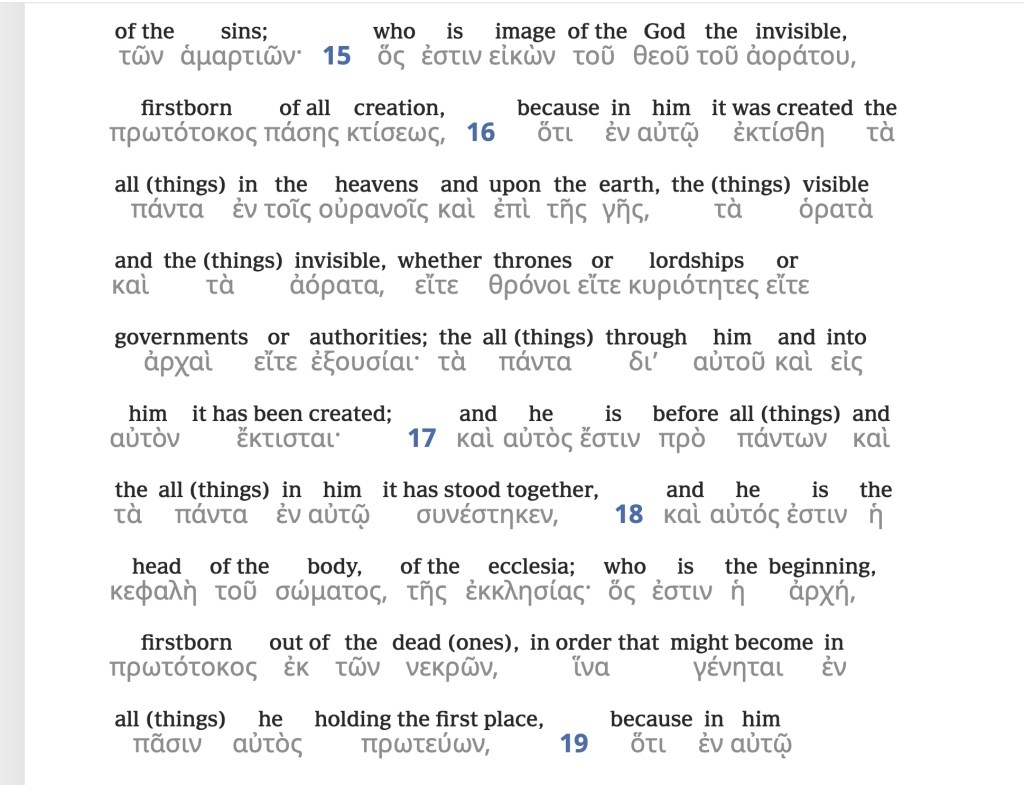
Their own Greek interlinear does not translate the phrase as “all other things” in verse 16. It is clear that the word “other” was added to support their predetermined narrative about Christ, in opposition to what Paul actually taught in Colossians 1:15–18.
Link: https://www.jw.org/en/library/bible/kingdom-interlinear-greek-translation/books/colossians/1/
Plain Greek Interlinear:
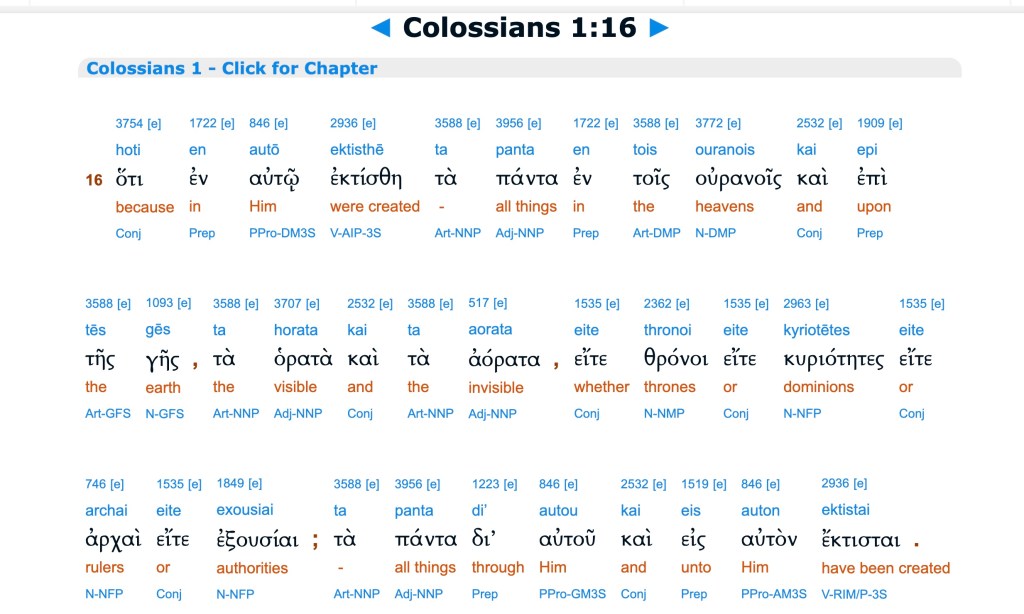
Link: https://biblehub.com/interlinear/colossians/1-16.htm
In light of everything shown above, it is evident that the Jehovah’s Witness translation alters Colossians 1:16 to make it say what they want it to say, rather than what Paul originally wrote. Jesus Christ, our Lord and Savior, is not created, nor is He the creator of “all other things.” He is the eternal Son of God, from whom and through whom all things (ta panta) came into existence. This is the consistent teaching of God’s Word. If Jehovah’s Witnesses consider themselves true stewards of Scripture, they must answer a simple question:
Would Paul’s Christology contradict the Christology of the other New Testament writers? The answer is no. This is why Paul wrote:
“For in him all things (ta panta) were created…” (Colossians 1:16)
Echoing what the Apostle John wrote in his Gospel:
“All things (ta panta) came into being through Him, and apart from Him nothing came into being that has come into being.” (John 1:3)
God’s Word does not present a contradictory or counterintuitive theology about Jesus. It is clear and consistent: believers place their faith in a Savior who is the eternal Creator of all things.
There will be a part two to this!


 KenTheExegete
Leave a comment