What Are the Synoptic Gospels, and Where Do They Come From?

This article comes from Zondervan Academic and provides a clear overview of the Synoptic Gospels.

Link to this artice: https://zondervanacademic.com/blog/synoptic-gospels

The Bible’s four gospels paint four portraits of Jesus. While each gospel follows him on the same journey, they recount it a little differently. They had their own methods, styles, purposes, audiences, and (probably) sources—making each portrait of Jesus uniquely valuable.

Despite their unique qualities, the first three gospels—Matthew, Mark, and Luke—share many of the same accounts of Christ, often shared in the same order and with the same wording. Because of their similar perspectives on Jesus’ ministry, together they’re known as the synoptic gospels. (The word “synoptic” comes from the Greek word synoptikos, meaning “able to be seen together.”)

While the differences between the gospels can be a challenge for us, these similarities can be problematic, too. The parallel passages between the synoptic gospels have left scholars with pressing questions about their origins. If Matthew, Mark, and Luke wrote about Jesus’ life and ministry from different perspectives, why are they so similar? If four people witnessed a car accident or a parade, they’d probably have loosely similar timelines, but significant variations in how they remember dialogue, what details they recall or omit, and how they describe it all. Yet these three gospels are remarkably similar. How did that happen?

The uncertain relationship between the synoptic gospels is known as “the synoptic problem.”

The synoptic problem

Looking at parallel passages, it’s hard to imagine that Matthew, Mark, and Luke don’t share a source or sources of some kind. What’s unclear is whether or not one or more of the gospels served as a source for the others.

For example, take a look at these passages where Jesus interacts with little children:

Matthew 19:13–14Mark 10:13–14Luke 18:15–16
“Then little children were brought to Jesus for him to place his hands on them and pray for them. But the disciples rebuked those who brought them. Jesus said, ‘Let the little children come to me, and do not hinder them, for the kingdom of heaven belongs to such as these.’ ”“People were bringing little children to Jesus to have him touch them, but the disciples rebuked them. When Jesus saw this, he was indignant. He said to them, ‘Let the little children come to me, and do not hinder them, for the kingdom of God belongs to such as these.’ ”“People were also bringing babies to Jesus to have him touch them. When the disciples saw this, they rebuked them. But Jesus called the children to him and said, ‘Let the little children come to me, and do not hinder them, for the kingdom of God belongs to such as these.’ ”

The quote from Jesus is identical in all three passages, and the text leading up to the quote has slightly different wording, but basically says the same thing. Matthew adds that people wanted Jesus to pray for the children. And the gospels are full of passages like these.

Two key questions we need to answer

The gospels don’t come with a “works cited” page. We don’t have a detailed list of sources to cross-examine. To answer the synoptic problem, scholars mostly have to work from the gospels themselves.

While that means solutions to the synoptic problem rely heavily on speculation, there’s a lot we can deduce from the information we have, and many brilliant people have arrived at the same handful of conclusions.

There are two questions the synoptic problem challenges us to answer:

1. Did the synoptic gospel writers use each other as sources? There’s a clear overlap in material, but the gospels could have shared another source—some combination of written and oral—to produce such similar writings. If we decide that one or more of the gospels was a source for the others, this leads us to a more complicated question:

2. If so, which synoptic gospel was written first and which depended on the others? Without the gospels’ original manuscripts, we can’t just look at the dates to determine which came first. We have to use literary clues to identify which gospel (or gospels) seem to exert the greatest influence on the others.

5 signs the synoptic gospel writers used each other as sources

While some scholars believe each of the gospels was written completely independently of the others, several highly unlikely coincidences make that pretty hard to accept. Here’s why most scholars believe one or more of the gospel writers used the others as sources:

1. So much common material

The Gospel of John isn’t one of the synoptic gospels because it was clearly written independently. Over 90% of the Book of John is unique, that is, the book’s material is not found in any of the other three gospels.

If the synoptic gospels were written independently, we’d expect a significant portion of those gospels to be unique as well. However, over 90% of Mark appears in either Matthew or Luke, and in many cases the wording is unchanged or barely different.

2. So much verbal agreement

While it’s completely possible that the disciples memorized the exact words of Jesus, quotes alone can’t account for the similar wording in the synoptic gospels. Matthew, Mark, and Luke contain entire sentences that are the same word for word, even in narrative material.

These numerous instances of exact matches seems to suggest that the writers worked from the same written material—if they separately worked through oral material years apart, it’s unlikely that they would have all preserved these accounts of Christ verbatim.

3. So much agreement in order

It’s not just the precise wording of parallel passages that raises eyebrows. While some of these passages appear to occur at different times in different gospels, there are numerous instances where the gospel writers presented accounts of Jesus in the same order—even when they don’t appear to be recording the chronological order of events. Towards the beginning of Jesus’ ministry, the gospels all present the following events in the same order:

  • Jesus heals the paralyzed man (Matthew 9:1–8, Mark 2:1–12, Luke 5:17–26)
  • Jesus eats with sinners and tax collectors (Matthew 9:9–13, Mark 2:13–17, Luke 5:27–32)
  • Jesus is questioned about fasting (Matthew 9:14–17, Mark 2:18–22, Luke 5:33–39)
  • Jesus heals on the Sabbath (Matthew 12:1–14, Mark 3:1–6, Luke 6:1–11)
  • Paying taxes to Caesar (Matthew 22:15–22, Mark 12:13–17, Luke 20:20–26)
  • Marriage at the resurrection (Matthew 22:23–33, Mark 12:18–27, Luke 20:27–40)
  • Whose son is the messiah? (Matthew 22:41–46, Mark 12:35–37, Luke 20:41–44)
  • Warning against the teachers of the Law (Matthew 23:1–12, Mark 12:38–40, Luke 20:45–47)

While you’ll find some unique accounts in between, these passages are never rearranged in any of the synoptic gospels. So now we have much of the same material worded the same way and appearing in the same order. The gospel writers certainly aren’t copying everything from each other, but these similarities suggest that each gospel writer is drawing from common material.

4. Agreements in comments and asides

If you and a friend were to tell the same story from your own perspective, what are the chances you’d both choose the same moment to provide commentary? The writers of the synoptic gospels frequently follow the same patterns in their narratives, pausing for parenthetical statements in the same places. Take a look at where the writer breaks up Jesus’ quote (which happens to be a word-for-word quotation):

Matthew 9:6Mark 2:10–11Luke 5:24
“ ‘But so that you may know that the Son of Man has authority on earth to forgive sins….’ Then he said to the paralytic, ‘Get up, take your mat and go home.’ ”“ ‘But that you may know that the Son of Man has authority on earth to forgive sins….’ He said to the paralytic, ‘I tell you, get up, take your mat and go home.’ ”“ ‘But that you may know that the Son of Man has authority on earth to forgive sins….’ He said to the paralyzed man, ‘I tell you, get up, take your mat and go home.’ ”

Even when the wording isn’t exactly the same, the writers choose the same opportunities to add narrative asides. You can see this in Matthew 24:15 and Mark 13:14, Mark 5:8 and Luke 8:29, and Matthew 27:18 and Mark 15:10.

So is this a coincidence? Not likely. If a writer has details to add to the story, they could choose any number of places to add that information. The chances that all three writers would happen to choose the same locations to add the same details—without using one of the other writers as a model—are pretty small. Add that to the fact that many of these same events are recorded with the same (or similar) wording in the same order, and you’ve got a pretty good case for one of these three gospels influencing the other two.

Now here’s the kicker:

5. Identical alterations of the same Old Testament quotes

When Matthew, Mark, and Luke introduce John the Baptist, all three of them quote Isaiah 40:3 from the Septuagint, which includes the phrase “make straight paths for our God.” All three synoptic gospels make the exact same alteration to that phrase, changing it to “make straight paths for him.”

Matthew 3:3Mark 1:2–3Luke 3:4
“This is he who was spoken of through the prophet Isaiah: ‘A voice of one calling in the desert, “Prepare the way for the Lord, make straight paths for him.” ’ ”“It is written in Isaiah the prophet: ‘… a voice of one calling in the desert, “Prepare the way for the Lord, make straight paths for him.” ’ ”“As is written in the book of the words of Isaiah the prophet: ‘A voice of one calling in the desert, “Prepare the way for the Lord, make straight paths for him.” ’ ”

It’s pretty hard to argue that all three writers made the same changes to the same Old Testament quote in the same context completely independently. At some point you have to ask, how many coincidences does it take to equal proof? When the same material is shared with the same words, in the same order, with the same side comments, and the same altered quotes, most scholars agree: one of these gospels was a source for the others—so which is it?

The first solution to the synoptic problem was proposed more than a millennium ago, when St. Augustine of Hippo first noticed the signs suggesting the gospels weren’t written independently.

Augustine’s solution: Mark and Luke borrow from Matthew

Despite all the writings we have from the early church fathers, we don’t have an extensive exploration of the synoptic problem. In fact, what we do have seems to suggest that the early church fathers didn’t see a problem at all. The second-century church father Papias claimed Mark wrote Peter’s version of the gospel, and that Matthew wrote a collection of ta logia—literally, “the oracles”—of Jesus, meaning a collection of his sayings (which may or may not have been the Gospel of Matthew).

It seems that Augustine first identified and focused on the apparent relationship between the synoptic gospels. He believed Matthew wrote first and that Mark took Matthew’s account and abbreviated it. Luke then wrote his gospel using both Matthew and Mark’s gospels as sources.

Augustine-solution-synoptic-problem

In the video at the top of this post, Dr. Mark Strauss suggests “[Augustine] probably drew this conclusion based on their canonical order: that Matthew was first, Mark was second, and Luke was third.” Since Augustine’s first keen observations, scholars have found other reasons to support the notion that Matthew wrote first.

Are the synoptic gospels actually based on Matthew?

One of the two major solutions to the synoptic problem is known as Matthean priority, which claims Matthew came first. Unlike Augustine, modern proponents of Matthean priority believe that Luke used Matthew as a source, and then Mark used both, abbreviating them throughout his own gospel.

This is known as the Griesbach hypothesis (named after an influential eighteenth-century scholar who supported it), or the two-gospel hypothesis, since it claims Matthew and Luke were the source for Mark.

Griesbach-hypothesis-synoptic-problem

There are three main reasons many Bible scholars hold this view:

1. Church tradition supports a Matthew-first view.

Early Christians were closest to the original sources, and until the nineteenth century the church largely assumed that Matthew came first. Church tradition seems to support Matthean priority.

2. Matthew and Luke occasionally agree against Mark.

The strongest argument for Matthean priority is that there are instances in which Matthew and Luke agree, and Mark does not. This view assumes that Mark’s departure from Matthew and Luke is due to Mark abridging the two longer gospels.

3. There is no physical evidence for additional sources.

Proponents of Matthean priority argue that other views (such as Markan priority, discussed below) rely on additional sources, despite no physical evidence that such sources exist. The difference between this theory and Augustine’s solution is simply a matter of who wrote second (Mark or Luke), and who wrote third, using the other two as sources. Both of these Matthean priority theories solve the synoptic problem without the need for additional sources.

The problem with this argument is that Matthew and Luke both contain unique material we don’t see in any of the other synoptic gospels. That material had to come from somewhere, and while an additional source currently only exists in theory, it’s one of the main reasons most scholars instead believe Mark came first.

Are the other synoptics based on Mark?

Most scholars find the Matthean priority argument less convincing than the evidence for Markan priority: the idea that Mark came first. There are several significant reasons to support this view:

Markan-Priority-synoptic-problem

1. Most of Mark is included in Matthew and Luke.

About 93% of the material in Mark is in found in either Matthew or Luke. So did Mark take material from both, or did Matthew and Luke take material from Mark?

While some have argued that Mark is an abridged version of the other Synoptics, comparing accounts from Mark to their parallel passages appears to suggest otherwise. For example:

  • The account of the demon-possessed man in Mark 5:1–20 has 325 words
  • Whereas the parallel passage in Matthew 8:28–34 only has 135 words.

If Mark is using Matthew as his main source for this story, why does he have significantly more detail? If anything, it seems more likely that Matthew and Luke are providing abbreviated versions of the accounts in Mark.

2. Mark occasionally uses Aramaic words.

Whereas Mark retains some of the words from Jesus’ native tongue, Aramaic—such as talitha koum in Mark 5:41 and abba in Mark 14:36—Matthew and Luke consistently provide the Greek translations. If Mark got this material from Matthew or Luke, why would he translate it out of Greek and back into Jesus’ native tongue?

Furthermore, Mark’s Greek isn’t polished in some areas, and Matthew and Luke both appear to smooth over Jesus’ language when there is shared material.

It seems likely that Matthew and Luke would have encountered Aramaic words in Mark’s gospel and translated them into Greek, knowing the words would be unfamiliar to their audiences.

2. If Mark is copying Luke or Matthew, why does he leave so much out?

While there’s a lot of overlap in the stories and accounts found in the Synoptics, Mark is missing some great materials found in Matthew and Luke. If he were working from their material, why would he leave out the Sermon on the Mount?

3. The Synoptics generally follow Mark’s order of events.

As we said earlier, many of the major accounts in the Synoptics appear in the same order in all three gospels. But when Matthew presents events in a different order than Mark, Luke follows Mark’s order. And when Luke presents events in a different order than Mark, Matthew follows Mark’s order.

It appears that Mark’s order is the original, and the other two are trying to follow it. Most scholars would suggest that the deviations occur when Matthew and Luke choose to follow another source besides Mark.

Mark may not be the only source of the other synoptics

While almost all of Mark appears in either Matthew or Luke, there’s a lot of material in those two gospels that isn’t in Mark. If Mark was the only source, where did the other writers get important teachings of Jesus, like the Sermon on the Mount?

And we’re not just talking about accounts that are unique to each gospel—Matthew and Luke share material not found in Mark, sometimes with nearly the same wording, such as in Matthew 6:24 and Luke 16:13.

Mark alone can’t account for all of the material in the synoptic gospels, so in order for Markan priority to hold water, scholars had to propose additional sources.

As we discussed earlier, there’s no physical evidence of an additional source beyond the three synoptic gospels. However, after analyzing the similarities and differences between the three texts, most scholars believe that there was at least one other major source that the gospel writers relied on. This is why scholars have expanded on Markan priority with the two-source theory and the four-source theory.

The two-source theory: The synoptics borrow from Mark & “Q”

Since no additional text has been discovered, scholars dubbed the unknown text source “Q” (probably an abbreviation of quelle, the German word for “source”). It’s also referred to as the “Synoptic Sayings Source.”

Since most of the material exclusive to Matthew and Luke is sayings of Jesus with a few narratives, the two-source theory suggests that one additional source is enough to account for the differences between the Synoptics.

two-source-theory-synoptic-problem

At this point, you may be thinking, “wait—what is this ‘Q’?”

If one of the most widely-accepted solutions to the synoptic problem hinges on a source that only exists in theory, how do scholars explain this source?

Q could be a figment of scholarly imagination

Scholars who don’t support Markan priority argue that “Q” isn’t necessary. To them, the overlap between Matthew and Luke is simply the material Luke borrowed from Matthew. However, this doesn’t explain the material unique to Luke, such as the Good Samaritan or the Prodigal Son.

Q could be a variety of sources, written and oral

To some scholars, the exact nature of “Q” is less important—it could be a body of literature or a variety of oral accounts of Christ not recorded anywhere else.

Q could be a single written source

Since Matthew and Luke frequently use the exact same language to describe events or teachings not recorded in Mark, and they often present them in the same order, many scholars believe “Q” to be a single written source.

Q represents a heterodox community of Christians

Other scholars believe that “Q” goes beyond a single written source, and that it actually represents the core beliefs of a specific group of Christians with their own theology. While the four main views of “Q” are all theories, this one reaches farthest beyond the available evidence.

But Q may not be enough

Some scholars have a problem with the two-source theory: there’s material that appears exclusively in Matthew, and other material that appears exclusively in Luke. It’s possible that each writer simply omitted some of the second source that the other included, and visa versa.

Or maybe two sources aren’t enough to account for the unique material.

The four-source theory: Mark, Q, M, and L

In addition to Q, the four-source theory claims that the unique material in Matthew and unique material in Luke must have come from additional sources, dubbed M (Matthew’s other source) and L (Luke’s other source).

four-source-theory-synoptic-problem

While other Markan priority theories exist, most modern New Testament scholars support some form of the four-source theory. Despite the lack of physical evidence, the literary evidence in the texts themselves makes a strong case that the gospel writers had additional sources, either text-based or oral.

Doesn’t divine inspiration solve the problem?

You might be wondering in all of this, “What about the Holy Spirit?”

Couldn’t God give certain insights to each writer? Why does the synoptic problem have to be answered with evidence, not just inspiration?

Answering the synoptic problem with the Holy Spirit actually forces us to ignore some of the evidence for interdependent gospels—evidence that God included in His divinely-inspired Word.

For example, Luke explicitly tells us he used sources (Luke 1:1-4). Acknowledging and investigating this doesn’t undermine the Bible’s divine authority and inspiration. It helps us trace the path of God’s inspiration. We need to ask, “What did the Holy Spirit use to inspire the gospel writers?”

The origin of the synoptic gospels and their relationships to each other have been the subject of study for centuries, and we still don’t have a definitive answer to the synoptic problem. While the majority of scholars rally behind some version of Markan priority, the debate can only deal in the realm of theory.

This isn’t to say that we can simply shrug at the similarities and differences between the gospels. There’s textual evidence that supports the existence of “Q,” even if we never find physical, written documents.

Ancient cultures placed a lot of weight on oral tradition, sometimes considering a personal account passed on through word-of-mouth to be more accurate than written sources. The early church father Papias once said, “For I did not suppose that information from books would help me so much as the word of a living and surviving voice.”

The closest we may ever get to the origins of the synoptic gospels may very well be the opening lines of Luke:

Many have undertaken to draw up an account of the things that have been fulfilled among us, just as they were handed down to us by those who from the first were eyewitnesses and servants of the word. With this in mind, since I myself have carefully investigated everything from the beginning, I too decided to write an orderly account for you, most excellent Theophilus, so that you may know the certainty of the things you have been taught.” —Luke 1:1–4 (emphasis added)
CHRIST’S HUMBLING AND EXALTATION IN PAUL’S LETTERS

Here is a list of passages where the Apostle Paul mentions Jesus coming into the world to dwell as a humble servant, perfectly obedient to the will of God the Father. As a result, He’s exalted above all creation and worshipped as the divine Lord and Savior.

The Obedience That Undoes Adam’s Fall

Paul frames Christ’s humbling as His obedience unto death, which becomes the basis for His exalted role as the source of righteousness for many.

Therefore, as one trespass led to condemnation for all men, so one act of righteousness leads to justification and life for all men. For as by the one man’s disobedience the many were made sinners, so by the one man’s obedience the many will be made righteous. Romans 5:18–19

God Sends the Son in Weakness

Christ enters the world “in the likeness of sinful flesh,” taking on weakness so He can condemn sin and restore creation.


For God has done what the law, weakened by the flesh, could not do. By sending his own Son in the likeness of sinful flesh and for sin, he condemned sin in the flesh. Romans 8:3

He Died and Rose to Become Lord of All

Paul shows the pattern clearly: Christ died (humbling) and rose (exaltation) so that He might be Lord over both the dead and the living.


For to this end Christ died and lived again, that he might be Lord both of the dead and of the living. Why do you pass judgment on your brother? Or you, why do you despise your brother? For we will all stand before the judgment seat of God;
for it is written, “As I live, says the Lord, every knee shall bow to me, and every tongue shall confess to God.” Romans 14:9–11

The Descent Into Death and the Rise in Glory

Christ’s burial marks His deepest humbling; His resurrection is the beginning of His exaltation as the firstfruits of the new creation.

For I delivered to you as of first importance what I also received: that Christ died for our sins in accordance with the Scriptures, that he was buried, that he was raised on the third day in accordance with the Scriptures. 1 Corinthians 15:3–4

From Riches to Poverty to Riches Again

Paul uses economic imagery: Christ becomes “poor” in the incarnation so that through His poverty we might share in His exalted riches.


For you know the grace of our Lord Jesus Christ, that though he was rich, yet for your sake he became poor, so that you by his poverty might become rich. 2Corinthians 8:9

Raised, Seated, and Given All Authority

The Father exalts Christ by raising Him, seating Him above all powers, and placing everything under His feet.


that he worked in Christ when he raised him from the dead and seated him at his right hand in the heavenly places, far above all rule and authority and power and dominion, and above every name that is named, not only in this age but also in the one to come. And he put all things under his feet and gave him as head over all things to the church, which is his body, the fullness of him who fills all in all. Ephesians 1:20–23

The One Who Descended Is the One Who Ascended

Paul ties Christ’s descent to His ascent: the One who went down into the lower regions is the same One who ascended far above the heavens to fill all things.


But grace was given to each one of us according to the measure of Christ’s gift.
Therefore it says, “When he ascended on high he led a host of captives, and he gave gifts to men.” (In saying, “He ascended,” what does it mean but that he had also descended into the lower regions, the earth? He who descended is the one who also ascended far above all the heavens, that he might fill all things.) Ephesians 4:7–10

The Great Descent and the Great Exaltation

Christ empties Himself, takes the form of a servant, and dies — therefore God highly exalts Him and gives Him the name above every name.


Have this mind among yourselves, which is yours in Christ Jesus, who, though he was in the form of God, did not count equality with God a thing to be grasped, but emptied himself, by taking the form of a servant, being born in the likeness of men. And being found in human form, he humbled himself by becoming obedient to the point of death, even death on a cross. Therefore God has highly exalted him and bestowed on him the name that is above every name, so that at the name of Jesus every knee should bow, in heaven and on earth and under the earth, and every tongue confess that Jesus Christ is Lord, to the glory of God the Father. Philippians 2:5–11

The Preeminent One Who Reconciles Through the Cross

The One who is supreme over creation humbles Himself through the blood of the cross, and is exalted as the head of the new creation.


He is the image of the invisible God, the firstborn of all creation.For by him all things were created, in heaven and on earth, visible and invisible, whether thrones or dominions or rulers or authorities—all things were created through him and for him. And he is before all things, and in him all things hold together. And he is the head of the body, the church. He is the beginning, the firstborn from the dead, that in everything he might be preeminent. For in him all the fullness of God was pleased to dwell, and through him to reconcile to himself all things, whether on earth or in heaven, making peace by the blood of his cross. Colossians 1:15–20

Manifested Low, Vindicated High

Paul summarizes Christ’s story: manifested in the flesh (humbling), vindicated in the Spirit and taken up in glory (exaltation).


Great indeed, we confess, is the mystery of godliness: He was manifested in the flesh, vindicated by the Spirit, seen by angels, proclaimed among the nations, believed on in the world, taken up in glory. 1 Timothy 3:16

The Self-Giving Savior Who Will Appear in Glory

Christ gives Himself to redeem a people (humbling), and Paul points forward to His glorious appearing (exaltation).


waiting for our blessed hope, the appearing of the glory of ourgreat God and Savior Jesus Christ, who gave himself for us to redeem us from all lawlessness and to purify for himself a people for his own possession who are zealous for good works. Titus 2:13–14

The Judge Appointed Through Resurrection

In Paul’s preaching, Christ’s resurrection is the proof of His exalted authority as the appointed Judge of the world.


So Paul, standing in the midst of the Areopagus, said: “Men of Athens, I perceive that in every way you are very religious. For as I passed along and observed the objects of your worship, I found also an altar with this inscription: ‘To the unknown god.’ What therefore you worship as unknown, this I proclaim to you. The God who made the world and everything in it, being Lord of heaven and earth, does not live in temples made by man, nor is he served by human hands, as though he needed anything, since he himself gives to all mankind life and breath and everything. And he made from one man every nation of mankind to live on all the face of the earth, having determined allotted periods and the boundaries of their dwelling place, that they should seek God, and perhaps feel their way toward him and find him. Yet he is actually not far from each one of us, for “In him we live and move and have our being”; as even some of your own poets have said, “For we are indeed his offspring.” Being then the offspring of God, we ought not to suppose that the Divine Nature is like gold or silver or stone, an image formed by the craft and thought of man. Therefore having overlooked the times of ignorance, God is now commanding men that everyone everywhere should repent, because He has fixed a day in which He will judge the world in righteousness through a Man whom He determined, having furnished proof to all by raising Him from the dead.” Acts 17:22-31

The Apostles’ Creed- Interlinear Greek/English

The following is taken from this post: The Apostles Creek with Interlinear Greek and English

ENGLISHGREEK
I believe in God, the Father almighty,
      creator of heaven and earth.

I believe in Jesus Christ, his only Son, our Lord,
      who was conceived by the Holy Spirit
      and born of the virgin Mary.
      He suffered under Pontius Pilate,
      was crucified, died, and was buried;
      he descended to hell.
      The third day he rose again from the dead.
      He ascended to heaven
      and is seated at the right hand of God the Father almighty.
      From there he will come to judge the living and the dead.
I believe in the Holy Spirit,
      the holy catholic* church,
      the communion of saints,
      the forgiveness of sins,
      the resurrection of the body,
      and the life everlasting. Amen.
Πιστεύω εἰς Θεὸν Πατέρα παντοκράτορα, ποιητὴν οὐρανοῦ καὶ γῆς·
καὶ εἰς Ἰησοῦν Χριστὸν, τὸν Υἱὸν αὐτοῦ τὸν μονογενῆ, τὸν Κύριον ἡμῶν· τὸν συλληφθέντα ἐκ Πνεύματος Ἁγίου, γεννηθέντα ἐκ Μαρίας τῆς παρθένου· παθόντα ἐπὶ Ποντίου Πιλάτου, σταυρωθέντα, τεθνηκότα καὶ ταφέντα· κατελθόντα εἰς τὰ κατώτατα· τῇ τρίτῃ ἡμέρᾳ ἀναστάντα ἐκ νεκρῶν· ἀνελθόντα εἰς τοὺς οὐρανούς, καθήμενον ἐκ δεξιῶν Θεοῦ Πατρὸς παντοκράτορος· ἐκεῖθεν ἐρχόμενον κρῖναι ζῶντας καὶ νεκρούς·
Πιστεύω εἰς τὸ Πνεῦμα τὸ Ἅγιον· ἁγίαν καθολικὴν Ἐκκλησίαν· ἁγίων κοινωνίαν· ἄφεσιν ἁμαρτιῶν· σαρκὸς ἀνάστασιν· ζωὴν αἰώνιον· ἀμήν.

INTERLINEAR
Πιστεύω
I believe
Πιστεύω
4100
εἰς
in
εἰς
1519
θεòν
God
θεός
2316
πατέρα
the Father
πατήρ
3962
παντοκράτορα
the Almighty
παντοκράτωρ
3841
ποιητὴν
the maker
ποιητής
4163
οὐρανοῦ
of heaven
οὐρανός
3772
καὶ
and
καὶ
2532
γῆς.
earth
γῆ
1093
Καὶ
and
καὶ
2532
(εἰς)
in
εἰς
1519
Ἰησοῦν
Jesus
Ἰησοῦς
2424
Χριστòν
Christ
χριστός
5547
υἱὸν
Son
υἱός
5207
αὐτοῦ
His
αὐτός
846
τòν
the

3588
μονογενῆ
only begotten
μονογενής
3439
τòν
the

3588
κύριον
Lord
κύριος
2962
ἡμῶν
our
ἐγώ
1473
τòν
the

3588
συλληφθέντα
concieved
συλλαμβάνω
4815
ἐκ
by
ἐκ
1537
πνεύματος
Spirit
πνεῦμα
4151
ἁγίου
Holy
ἅγιος
40
γεννηθέντα
born
γεννάω
1080
ἐκ
of
ἐκ
1537
Μαρίας
Mary
Μαρία
3137
τῆς
the

3588
παρθένου
virgin
παρθένος
3933
παθόντα
suffered
πάσχω
3958
ἐπὶ
under
ἐπὶ
1909
Ποντίου
Pontius
πόντιος
4194
Πιλάτου
Pilate
Πιλᾶτος
4091
σταυρωθέντα
was crucified
σταυρόω
4717
θανόντα
died
θνήσκω
2348
καὶ
and
καὶ
2532
ταφέντα
was buried
θάπτω
2290
κατελθόντα
descended
κατέρχομαι
2718
εἰς
into
εἰς
1519
τὰ
the

3588
κατώτατα
Hell
κάτω
2736
τῇ
the

3588
τρίτῃ
third
τρίτος
5154
ἡμέρᾳ
day
ἡμέρα
2250
ἀναστάντα
rising
ἀνίστημι
450
ἀπò
from
ἀπò
575
τῶν
the

3588
νεκρῶν
dead
νεκρός
3498
ἀνελθόντα
ascending
ἀνέρχομαι
424
εἰς
into
εἰς
1519
τοὺς
the

3588
οὐρανούς
heavens
οὐρανός
3772
καθεζόμενον
being seated
καθέζομαι
2516
ἐν
at
ἐν
1722
δεξιᾷ
the right hand
δεξιός
1188
θεοῦ
of God
θεός
2316
πατρὸς
the Father
πατήρ
3962
παντοδυνάμου
Almighty
παντοδύναμις
3956 1411
ἐκεῖθεν
from there
ἐκεῖθεν
1564
ἐρχόμενον
coming
ἔρχομαι
2064
κρῖναι
to judge
κρίνω
2919
ζῶντας
living
ζάω
2198
καὶ
and
καὶ
2532
νεκρούς.
dead
νεκρός
3498
Πιστεύω
I believe
Πιστεύω
4100
εἰς
in
εἰς
1519
τò
the

3588
πνεῦμα
Spirit
πνεῦμα
4151
τò
the

3588
ἅγιον
Holy
ἅγιος
40
ἁγίαν
the holy
ἅγιος
40
καθολικὴν
catholic
καθολικός
2526
ἐκκλησίαν
church
ἐκκλησία
1577
ἁγίων
of the saints
ἅγιος
40
κοινωνίαν
the communion
κοινωνία
2842
ἄφεσιν
the forgiveness
ἄφεσις
859
ἁμαρτιῶν
of sins
ἁμαρτία
266
σαρκὸς
of the body
σάρξ
4561
ἀνάστασιν
the resurrection
ἀνάστασις
386
ζωὴν
life
ζωή
2222
αἰώνιον.
eternal
αἰώνιος
166
ἀμήν
Amen
ἀμήν
281
  • Strong’s Numbers are hyper-linked to the Blue Letter Bible

If Jesus is God, How Can God Die?

The following is a reply article by Sam Shamoun addressing objections from Muslims and other anti-Trinitarians about the deity of Jesus Christ.

By: Sam Shamoun

Question:

If Jesus is God, how can God die? Who was running the universe those three days that Jesus was dead?

Answer:

Implicit in the question is the assumption that death implies non-existence, so to say Jesus died implies that God ceased to exist, which cannot happen. The problem is that the definition of death is wrong since according to the holy Scriptures death does not mean non-existence, but rather refers to the separation that resulted from Adam’s rebellion against God. The Scriptures tell us that as a result of the first man’s sin, two types of separation occurred. The first is spiritual “death” where a person is severed from having fellowship with God, being separated from God’s loving, intimate presence. Instead of God’s love abiding upon an individual, it is the divine wrath that rests upon him:

“The LORD God took the man and put him in the Garden of Eden to work it and take care of it. And the LORD God commanded the man, ‘You are free to eat from any tree in the garden; but you must not eat from the tree of the knowledge of good and evil, for when you eat of it you will surely die.’” Genesis 2:15-17

After disobeying God by eating from the forbidden tree, the man and his wife were then banished from the presence of God in Eden:

“And the LORD God said, ‘The man has now become like one of us, knowing good and evil. He must not be allowed to reach out his hand and take also from the tree of life and eat, and live forever.’ So the LORD God banished him from the Garden of Eden to work the ground from which he had been taken. After he drove the man out, he placed on the east side of the Garden of Eden cherubim and a flaming sword flashing back and forth to guard the way to the tree of life.” Genesis 3:22-24

Scriptures continue to elaborate on this spiritual separation that has occurred as a result of sin:

“For you are not a God who delights in wickedness; evil will not sojourn with you. The boastful will not stand before your eyes; you hate evildoers. You destroy those who speak lies; the LORD abhors the bloodthirsty and deceitful.” Psalm 5:4-6 NRSV

“If I regard iniquity in my heart, the Lord will not hear.” Psalm 66:18

“Rather, your iniquities have been barriers between you and your God, and your sins have hidden his face from you so that he does not hear.” Isaiah 59:2

“Then they will cry to the LORD, but He will not hear them; He will even hide His face from them at that time, because they have been evil in their deeds.” Micah 3:4

“Your eyes are too pure to behold evil, and you cannot look on wrongdoing…” Habakkuk 1:13

“But because of your stubbornness and your unrepentant heart, you are storing up wrath against yourself for the day of God’s wrath, when his righteous judgment will be revealed… But for those who are self-seeking and who reject the truth and follow evil, there will be wrath and anger.” Romans 2:5, 8

“As for you, you were DEAD in your transgressions and sins, in which you used to LIVE when you followed the ways of this world and of the ruler of the kingdom of the air, the spirit who is now at work in those who are disobedient. All of us also lived among them at one time, gratifying the cravings of our sinful nature and following its desires and thoughts. Like the rest, we were by nature objects of wrath. But because of his great love for us, God, who is rich in mercy, made us ALIVE with Christ even when we were DEAD in transgressions–it is by grace you have been saved.” Ephesians 2:1-5

In this last passage, Paul speaks of believers being dead in sin prior to their regeneration and union with the Lord Jesus. Yet it is obvious that believers were still conscious and alive when they were dead in sin. Being dead in sin doesn’t mean ceasing to exist, but refers to being separated from loving union with God, just as the passage itself states.

The second type of “death” that the Holy Bible refers to is physical death. This is where the soul/spirit departs from the body and the body returns to the ground from which it came. And, as our sin-bearer, the Lord Jesus experienced both types of death, i.e. the loss of intimate communion with God and his soul departing from his body. We will have a lot more to say about this in response to the next question in our series.

Yet, neither types of death results in non-existence or cessation of life. Note for example, the following citations:

“But you have come to Mount Zion, to the heavenly Jerusalem, the city of the living God. You have come to thousands upon thousands of angels in joyful assembly, to the church of the firstborn, whose names are written in heaven. You have come to God, the judge of all men, to the spirits of righteous men made perfect, to Jesus the mediator of a new covenant, and to the sprinkled blood that speaks a better word than the blood of Abel.” Hebrews 12:22-24

“As the body without the spirit is dead, so faith without deeds is dead.” James 2:26

“When he opened the fifth seal, I saw under the altar the souls of those who had been slain because of the word of God and the testimony they had maintained. They called out in a loud voice, “How long, Sovereign Lord, holy and true, until you judge the inhabitants of the earth and avenge our blood?” Then each of them was given a white robe, and they were told to wait a little longer, until the number of their fellow servants and brothers who were to be killed as they had been was completed.” Revelation 6:9-11

Interestingly, not only is the questioner’s definition of death unbiblical, it is also contrary to the Quran:

And say not of those slain in God’s way, ‘They are dead’; rather they are living, but you are not aware. S. 2:154

Count not those who were slain in God’s way as dead, but rather living with their Lord, by Him provided, rejoicing in the bounty that God has given them, and joyful in those who remain behind and have not joined them, because no fear shall be on them, neither shall they sorrow, S. 3:169-170

This echoes the words of the Lord Jesus Christ:

“But in the account of the bush, even Moses showed that the dead rise, for he calls the Lord ‘the God of Abraham, and the God of Isaac, and the God of Jacob.’ He is not the God of the dead, but of the living, for to him all are alive.” Luke 20:37-38

Christ, therefore, did not cease to live when he died on the cross since, as the Holy Bible teaches, the Lord’s soul was still consciously alive during the three days his body lay in the tomb:

“Jesus answered them, ‘Destroy this temple, AND I WILL RAISE IT AGAIN IN THREE DAYS.’ The Jews replied, ‘It has taken forty-six years to build this temple, and YOU are going to raise it in three days?’ But the temple he had spoken of was HIS BODY. After he was raised from the dead, his disciples recalled what he had said. Then they believed the Scripture and the words that Jesus had spoken.” John 2:19-22

“The reason my Father loves me is that I lay down my life–only to take it up again. No one takes it from me, but I lay it down OF MY OWN ACCORD. I have authority to lay it down and authority to take it up again. This command I received from my Father.” John 10:17-18

The only way that Christ could be able to raise himself from the dead is if Christ were still consciously alive. This establishes that Christ did not cease to exist for those three days that his body remained in the grave. Both Christ’s divine nature and his human soul were still conscious during that period of time.

So in answer to the question, the one true God always exists as three distinct Persons even during the entombment of Christ’s physical body. And, even as his body lay buried, Christ was alive and sovereignly sustaining the universe along with the Father and the Holy Spirit.

Link to this article: https://www.answering-islam.org/Shamoun/q_god_dying.htm

Link to his other writings: https://www.answering-islam.org/

Jesus as the Divine Lord “YHWH” in Peter

The purpose of this article is to present how the Apostle Peter depicts Jesus as Yahweh God in human flesh, whom all believers must follow and give reverence to diligently.

PETER LXX1
SPIRIT OF YHWH JESUS
“Concerning this salvation, the prophets, who prophesied of the grace that would come to you, made careful searches and inquiries, inquiring to know what time or what kind of time the Spirit of Christ within them was indicating as He was predicting the sufferings of Christ and the glories to follow. It was revealed to them that they were not serving themselves, but you, in these things which now have been declared to you through those who proclaimed the gospel to you by the Holy Spirit sent from heaven—things into which angels long to look.” 
1 Peter 1:10-12
The Spirit of Yahweh spoke by me, And His word was on my tongue. The God of Israel said, The Rock of Israel spoke to me, ‘He who rules over men as a righteous one, Who rules in the fear of God,’” 2 Samuel 23:2-3 

“You gave Your good Spirit to give them insight, Your manna You did not withhold from their mouth, And You gave them water for their thirst… However, You bore with them for many years, And testified to them by Your Spirit by the hand of Your prophets, Yet they would not give ear. So You gave them into the hand of the peoples of the lands.” Nehemiah 9:20, 30

Draw near to Me, hear this: From the first I have not spoken in secret, From the time it took place, I was there. So now Lord Yahweh has sent Me, and His Spirit.”” Isaiah 48:16
OUR JUST GOD AND SAVIOR Simeon Peter, a slave and apostle of Jesus Christ, To those who have received the same kind of faith as ours, by the righteousness of our God and Savior, Jesus Christ (dikaiosyne tou Theou hemon kai Soteros ‘Iesou Christou):” 2 Peter 1:1“Declare and draw near with your case; Indeed, let them consult together. Who has made this heard from of old? Who has long since declared it? Is it not I, Yahweh? And there is no other God besides Me, A righteous God and a Savior; There is none except Me. Turn to Me and be saved, all the ends of the earth; For I am God, and there is no other.” Isaiah 45:21-22

Note the connection in Greek:
“If they will declare, let them draw nigh, that they may know together, who has caused these things to be heard from the beginning: then was it told you. I am God (ego ho Theos), and there is not another beside me; a just [God] and a Saviour (dikaios kai Soter); there is none but me.” Isaiah 45:21 LXX
TASTE AND SEE THAT YHWH JESUS IS GOOD!Therefore, laying aside all malice and all deceit and hypocrisy and envy and all slander, like newborn babies, long for the pure milk of the word, so that by it you may grow in respect to salvation, if you have TASTED THE KINDNESS OF THE LORD (ei egeusasthe hoti chrēstos ho Kyrios). 1 Peter 2:1-3O taste and see that Yahweh is good; (geusasthe kai idete hoti chrēstos ho Kyrios)
How blessed is the man who takes refuge in Him!
Psalm 33:9 LXX; 34:8
SANCTIFYING CHRIST AS YHWH“For this is contained in Scripture: ‘Behold, I lay in Zion a choice stone, a precious corner stone, And he who believes upon Him will not be put to shame.’ This precious value, then, is for you who believe; but for those who disbelieve, ‘The stone which the builders rejected, This has become the chief corner stone,’ and, ‘A stone of stumbling and a rock of offense.’ They stumble because they are disobedient to the word, and to this stumbling they were also appointed.” 
1 Peter 2:6-8

“But even if you should suffer for the sake of righteousness, you are blessed. And do not fear their fear, and do not be troubled (ton de phobon auton me phobethete mede tarachthete), but sanctify Christ as Lord (Kyrion de, ton Christon hagiasate) in your hearts, always being ready to make a defense to everyone who asks you to give an account for the hope that is in you, yet with gentleness and fear,” 1 Peter 3:14-15 
“Let them not say, [It is] hard, for whatsoever this people says, is hard: but fear not ye their fear, neither be dismayed (ton de phobon autou ou me phobethete oude me tarachthete). Sanctify ye the Lord himself (Kyrion auton hagiasate); and he shall be thy fear. And if thou shalt trust in him, he shall be to thee for a sanctuary; and ye shall not come against [him] as against a stumbling-stone, neither as against the falling of a rock: but the houses of Jacob are in a snare, and the dwellers in Jerusalem in a pit.” Isaiah 8:12-14 LXX

Based on the evidence provided, Peter believes that Jesus is the Divine Lord (Yahweh) in the flesh. Hence, the evidence should drive us to love Christ more than we currently do and to cultivate a deeper desire to grow in our relationship with Him. This also shows the Christological consistency throughout the Bible. Our living hope as believers resides in Jesus, Yahweh our righteousness (Jeremiah 23:4-6; 1 Peter 1:3-5).

  1. Septuagint, the Greek translation of the Old Testament ↩︎

Our God and Lord Jesus Christ

The following excerpt is taken from the theological work titled The Trinity: Evidence and Issues, authored by Robert M. Bowman Jr. and J. Ed Komoszewski, published by World Publishing, Iowa Falls, IA, 1996, Chapter 17: “God the Son: Our God and Lord Jesus Christ,” p. 341-44.

In order that the name of our Lord Jesus may be glorified in you, and you in Him, according to the grace of our God and Lord Jesus Christ. (2 Thes. 1:12)

ὅπως ἐνδοξασθῇ τὸ ὄνομα τοῦ κυρίου ἡμῶν Ἰησοῦ ἐν ὑμῖν, καὶ ὑμεῖς ἐν αὐτῷ, κατὰ τὴν χάριν τοῦ θεοῦ ἡμῶν καὶ κυρίου Ἰησοῦ Χριστοῦ.

Most English versions follow the KJV in making a distinction between God and Christ by adding the article “the” in front of the word “Lord.” Thus, in most translations it reads, “our God and the Lord Jesus Christ.” But the Greek text is quite straightforward that the θεός “God” referred to is none other than Jesus Christ:

τοῦ θεοῦ ἠμῶν καί κυρίου Ἰησοῦ Χριστου

our God and Lord Jesus Christ

There are three different issues:

1. Does the Granville Sharp rule apply to this text?

2. Did Paul have in mind one or two persons?

3. Did he call Jesus θεός as well as κυρίος?

The Granville Sharp rule states that when two nouns of the same case are separated by the word καί, with the first noun having the article in front of it, but the second noun without the article, only one person is in view and is, thus, being described by both nouns. In contrast, when both nouns have a definite article, then two persons are in view. There are many New Testament passages which would not make any sense whatsoever if this rule was not observed.137

But does this rule apply when the nouns in question are names or titles such as θεός? Some commentators have answered in the negative.138 But there are many passages whose interpretation would be impossible unless we applied Sharp’s rule to them. For example, in Luke 20:37 the word θεός appears once with the article and then two times without the article.

The God of Abraham and God of Isaac and God of Jacob

τὸν θεὸνἈβραὰμ καὶ θεὸν Ἰσαὰκ καὶ θεὸν Ἰακώβ.

The absence of the article before the second and third occurrence of the word θεὸν in reference to “God of Isaac” and “God of Jacob” means that there is only one God in view, “the God of Abraham.” Thus, the God of Isaac and Jacob was not a different God from the God of Abraham. Clearly Sharp’s rule is needed to interpret this text.

For this reason, most Greek grammarians have stated that Jesus is called both God and Lord in 2 Thessalonians 1:12.139 We, thus, arrive at an interesting situation where the grammarians disagree with the majority of commentators who mainly for theological reasons do not want to follow a strict grammatical interpretation of the Greek text.

As A.T. Robertson points out, Winer “bases his objection on doctrinal grounds, a matter that does not per se concern the grammarian.”140 Examples of modern commentators allowing their theology to control the meaning of a text instead of the context or grammar are not hard to find.141

It should be the other way around. If we do not allow the grammar of the text to dictate our theology, we will end up arguing in a circle. Princeton’s B. B. Warfield explains:

It will probably be allowed that in strictness of grammatical rule, rigidly applied, this should mean, “according to the grace of our God and Lord Jesus Christ,” or if we choose so to phrase it, “according to the grace of our God, even the Lord Jesus Christ.” All sorts of reasons are advanced, however, why the strict grammatical rule should not be rigidly applied here. Most of them are ineffective enough and testify only to the reluctance of expositors to acknowledge that Paul can speak of Christ as God.… This “exegetical uncertainty” is in each case imposed upon the passage by reluctance to take it in the sense which it most naturally bears, and which is exegetically immediately given.… The reason is distinctly circular which denies to each of these passages in turn its natural meaning on the ground of lack of supporting usage, when this lack of supporting usage is created by a similar denial on the same ground of its natural meaning to each of the other passages. The ground of the denial in each case is merely the denial in the other cases. Meanwhile the usage is there, and is not thus to be denied away. If it may be, any usage whatever may be destroyed in the same manner. In these circumstances there seems no reason why the ordinary laws of grammar should not determine our understanding of 2 Thess. 1:12.141

Warfield is not the only scholar who believes that 2 Thess. 1:12 calls Jesus both God and Lord. Note the following comments:

A.T. Robertson: Here strict syntax requires, since there is only one article with theou and kuriou that one person be meant, Jesus Christ, as is certainly true in Titus 2:13; 2 Pet. 1:1.143

Schmiedel: grammar demands that one person be meant.”144

Lenski: Those who think that two persons are referred to, God and Christ, are sometimes governed by dogmatical interests, namely by their claim that Christ is never called God, at least not in such a direct way. For us no dogmatical interest is involved; it makes no difference whether Christ is here called God or not, elsewhere he is called God and is shown to be God. We thus have only a linguistic interest, and this is strongly in favor of one person, for one article (τοῦ) unites both nouns.145

Lange: Since the article stands before θεοῦ and not before κυρίου, it is altogether most natural with Hofmann, to refer θεοῦ also to Christ without this being, as Hilgenfeld supposes, a mark of spuriousness; for not merely Tit. 2:13, but also Rom. 9:5 speaks to our Christ in loftier terms than are agreeable to our modern critics (Compare John 20:28; 2 Pet. 1:1, 11). The distinction between God and Christ is not to be sustained by an appeal to texts like vv. 1 and 2, since there the article is wanting also before θεῶ, and θεοῦ146

Even the liberal theologian Bultmann had to bow before the grammar of the text and admit that it calls Christ God!147 Dr. Kenneth Wuest, one of the best Greek scholars of the twentieth century, renders the phrase in his Expanded Translation as: “our God, even the Lord Jesus Christ.”148

If this text, like Romans 9:5, were found in a non-biblical manuscript with someone else being called “God and Lord,” there would be no controversy. This passage is clearly a New Testament witness to the deity of Christ.

137. Acts 15:23; Acts 26:30; 1 Cor. 3:8, etc.

138. William Hendriksen, I and 2 Thessalonians (Grand Rapids: Baker, 1974), 164, n. 117.

139. H. Cremer, Biblico-Theological Lexicon of New Testament Greek (Edinburgh: Clark, 1883), 3rd ed., 281; Robertson, Grammar, 785–786; Moulton, Einleitung, 134; Schmiedel, 158.

140. Robertson, Grammar, 786.

141. Meyer, 587–588.

141. Meyer, 587–588.

143. Robertson, Word Pictures, 4:46.

144. Robertson, Grammar, 786.

145. Lenski, The Interpretation of St. Paul’s Epistles (Minneapolis: Augsburg: 1964), 398.

146. Lange, 2:120.

147. Bultmann, 1:129

148. Kenneth Wuest, The New Testament: An Expanded Translation (Grand Rapids: Eerdmans, 1989), 485. This refutes the claim that no English translation has “God” modifying Jesus. (Harris, 265).

JW’s on Colossians 1:16-17 Pt. 1

The Apostle Paul teaches in Colossians 1:16–17 that Jesus is the eternal God and the Creator of all things. Although Jehovah’s Witnesses do not believe that Jesus is the eternal God and Creator of all things, they acknowledge in their own commentary that, grammatically, the Greek New Testament presents Jesus as the eternal Son of God through whom all things came into existence.

JW’s Text and Commentary on the passage:

16  because by means of him all other things1 were created in the heavens and on the earth, the things visible and the things invisible, whether they are thrones or lordships or governments or authorities. All other things2 have been created through him and for him. 17  Also, he is before all other things, and by means of him all other things were made to exist

  1. by means of him all other things were created: God used “his beloved Son” (Col 1:13) in creating the things “in the heavens and on the earth, the things visible and the things invisible.” This would include the millions of other spirit sons in Jehovah God’s heavenly family, as well as the physical universe. (Ge 1:1; Da 7:9, 10; Joh 1:3; Re 5:11) Jesus was Jehovah’s firstborn Son and the only one created directly by God. (Heb 1:6; see study notes on Joh 1:14 and Col 1:15.) Logically, it was to this firstborn Son that Jehovah said: “Let us make man in our image, according to our likeness.”​—Ge 1:26.
  2. all other things: A literal rendering of the Greek text would be “all things.” (Compare Kingdom Interlinear.) HOWEVER, SUCH A RENDERING COULD GIVE THE IMPRESSION THAT JESUS WAS NOT CREATED BUT WAS THE CREATOR HIMSELF. And that idea would not agree with the rest of the Bible, including the preceding verse, which calls Jesus “the firstborn of all creation.” (Col 1:15; compare Re 3:14, where Jesus is called “the beginning of the creation by God.”) Also, the Greek word for “all” can in some contexts have the meaning “all other,” as for example at Lu 13:2 (“all other”); Lu 21:29 (“all the other”); Php 2:21 (“all the others”). This agrees with Paul’s inspired teaching found at 1Co 15:27: “God ‘subjected all things under his [Christ’s] feet.’ But when he says that ‘all things have been subjected,’ it is evident that this does not include the One who subjected all things to him.” So both the Bible’s teachings as a whole and the probable meaning of the Greek word used here support the rendering “all other things.”​—Compare study note on Php 2:9.

Link to text and commentary: https://www.jw.org/en/library/bible/study-bible/books/colossians/1/#v51001016

Notice in their commentary they admit that the literal rendering of Colossians 1:16 in Greek presents Jesus as the Creator, not a created being.

Here is where the eisegesis of the Watchtower becomes evident:

Although they acknowledge that the literal rendering of Colossians 1:16 teaches that Jesus is not created, they go out of their way to add the word “other” in order to support their theology. In other words, they recognize that Paul’s grammar refutes their Christology, but instead of accepting what the original text says — “all things” (ta panta) — the Watchtower Society inserts the word “other” to make the passage align with their doctrinal position.

Again:

because by means of him all other things were created in the heavens and on the earth, the things visible and the things invisible, whether they are thrones or lordships or governments or authorities. All other things2 have been created through him and for him.  Colossians 1:16 NWT

Now here is where the Watchtower Society and Jehovah’s Witnesses undermine their own argument grammatically:

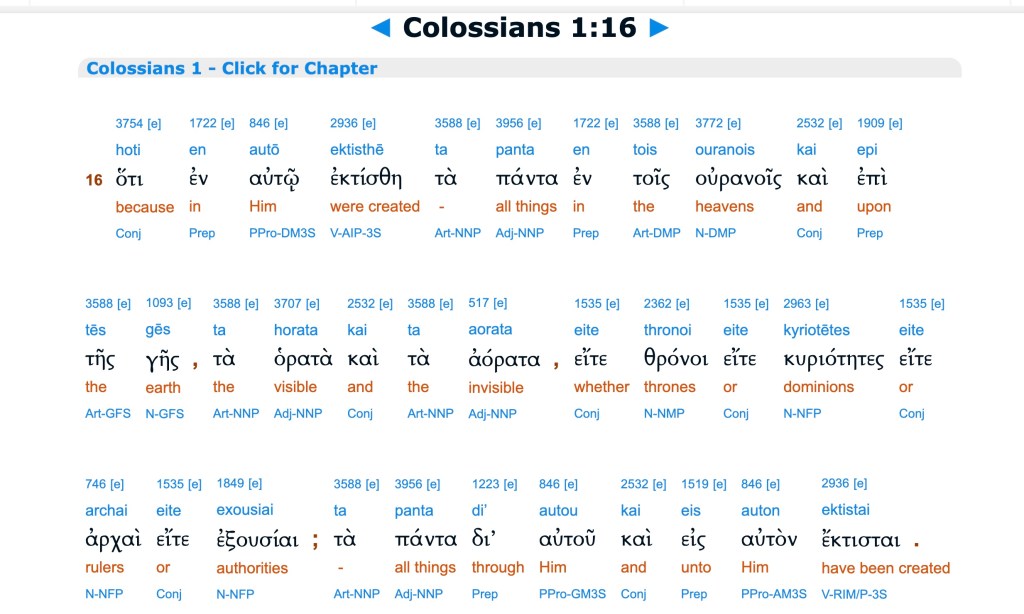
According to a literal translation of Colossians 1:16 in the original Greek, Paul writes, “For in him all things were created” (hoti en autō ektisthē ta panta), which they themselves acknowledge. However, the Watchtower Society contradicts its own position with its own interlinear translation of this passage.

Here’s a screenshot of the Kindgom Interlinear Translation of the Greek Scriptures:

Their own Greek interlinear does not translate the phrase as “all other things” in verse 16. It is clear that the word “other” was added to support their predetermined narrative about Christ, in opposition to what Paul actually taught in Colossians 1:15–18.

Link: https://www.jw.org/en/library/bible/kingdom-interlinear-greek-translation/books/colossians/1/

Plain Greek Interlinear:

Link: https://biblehub.com/interlinear/colossians/1-16.htm

In light of everything shown above, it is evident that the Jehovah’s Witness translation alters Colossians 1:16 to make it say what they want it to say, rather than what Paul originally wrote. Jesus Christ, our Lord and Savior, is not created, nor is He the creator of “all other things.” He is the eternal Son of God, from whom and through whom all things (ta panta) came into existence. This is the consistent teaching of God’s Word. If Jehovah’s Witnesses consider themselves true stewards of Scripture, they must answer a simple question:

Would Paul’s Christology contradict the Christology of the other New Testament writers? The answer is no. This is why Paul wrote:

“For in him all things (ta panta) were created…” (Colossians 1:16)

Echoing what the Apostle John wrote in his Gospel:

“All things (ta panta) came into being through Him, and apart from Him nothing came into being that has come into being.” (John 1:3)

God’s Word does not present a contradictory or counterintuitive theology about Jesus. It is clear and consistent: believers place their faith in a Savior who is the eternal Creator of all things.

There will be a part two to this!

Interpreting Colossians 1:15 in Context

The following excerpt is taken from the monumental work titled The Incarnate Christ and His Critics: A Biblical Defense, authored by Robert M. Bowman Jr. & J. Ed Komoszewski, published by Kregel Academic, Grand Rapids, MI, 2024, Part 2: Like Father, Like Son: Jesus’ Divine Attributes Chapter 13: Was Christ the First Creature, pp. 257-58.

Words vary in their precise meaning and connotation depending on context. If we want to understand what Paul meant by expression “first-born of all creation,” then we need to read it in context. This means looking at what the passage says leading up to that expression as well as what it says in the lines following it. Here is the statement in its context (translating very literally):

12 giving thanks to the Father, who qualified you for the share of the inheritance of the saints in the light;

13 who delivered us from the domain of the darkness and transferred [us] into the kingdom of the Son of his love,

14 in whom we have the redemption, the forgiveness of sins;

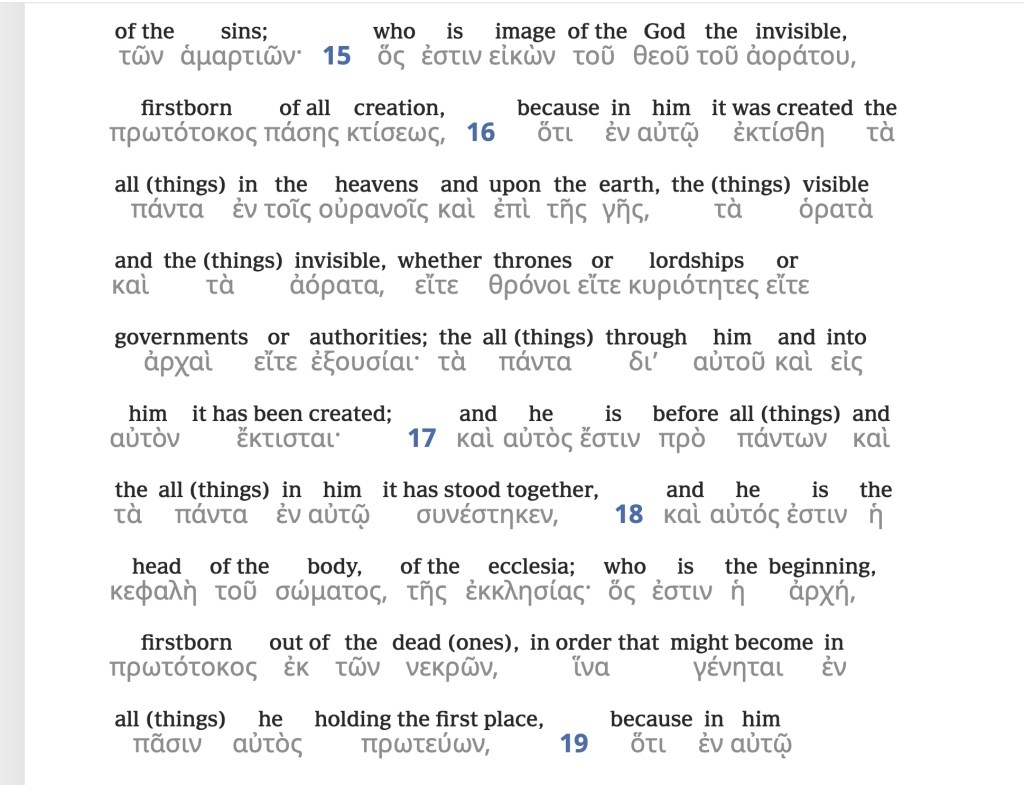
15 who is the image of the invisible God, the firstborn of all creation,

16 because in him all things were created-

in the heavens and on earth,

whether thrones or dominions

or rulers or authorities-

all things have been created through him and for him;

17 and he is before everything,

and all things in him hold together.

18 and he is the head of the body, the church

Who is the beginning, the first born from the dead,

so that he might become preeminent in everything. (Col. 1:12-18)

This passage strongly emphasizes Christ’s relationship to God the Father as his Son. Note the references to “the Father” (v.12) and the Son of his love” (v.13). Between these references Paul says that the Father has qualify Christians “for the share of the inheritance of the saints in the light.” The idea here is that the Father’s beloved Son in the primary heir of this “inheritance” from the Father, and yet those redeemed in Christ are graciously invited to receive a “share” of that inheritance. The other key theme that introduces our passage is that of kingdom or rule: we have been rescued from the domain or authority exousia of darkness and transferred into the kingdom basileia of God’s beloved Son (vv.13-14).

It is in this context of Father, Son, kingdom, and inheritance that we should understand the word “firstborn” (prōtótokos). Although the literal meaning of the word is the first offspring born to a biological parent, the cultural significance of the word is that of the father’s primary heir. In ancient Israel and Mediterranean world generally, the firstborn son in a family was customarily the father’s primary heir, inheriting that largest or best portion of his estate (and sometimes all of it). In the context of the preceding explicit reference to an “inheritance” and the use of the titles “Father and Son, this significance of firstborn as the primary heir is clearly the point of the term “firstborn.” As God the Father’s beloved Son, Christ rules the divine kingdom. Probably the main Old Testament text influencing this reference to Jesus as the “firstborn” is God’s promise to David to establish his kingdom forever above all other rulers: “And I will make him the firstborn, the highest of the kings of the earth” (Ps. 89:27). The title “firstborn” thus has clear messianic significance, in which, according to Paul, the Messiah (Christ) rules over all creation.

This understanding of Paul’s meaning is amply confirmed by what follows Immediately after calling the Son “the firstborn of all creation,” Paul says that “in him [the Son] all things were created.” Paul here distinguishes the Son from the creation by stating that all things were created in the Son, which means he was not one of the members of those created things. The words “all creation” (pasēs ktiseōs, v. 15)29 and “all things were created” (ektisthē ta panta, v. 16) are clearly synonymous in what they signify: pasēs and panta are two different grammatical forms of the same adjective meaning “all” or “every” and ktiseōs (“creation” or “creature”) is the noun corresponding to the verb ektisthē (“were created”) . In the Greek text, as in most English versions, these two expressions are separated by only three word, “for in him” (hoti en autō). Thus, Paul clearly is not including the Son in the category of “all creation.” Instead, he is saying that “all creation” was created in the Son.

29. The KJV translated this expression “every creation,” but every modern version we reviewed says “all creation.” For a detail explanation of why “all creation” is correct” is correct, see G. K. Beale, Colossians and Philemon, BECNT (Grand Rapids: Baker Academic, 2019), 86.

Jesus’s Teachings in James

Sermon on the Mount Jesus’ TeachingJames
“Blessed are the poor in spirit, for theirs is the kingdom of heaven.” Matt 5:3Those who don’t amount to much by the world’s standards should be glad, for God has honored them.“But the brother of humble circumstances is to boast in his high position;” James 1:9
“Blessed are the poor in spirit, for theirs is the kingdom of heaven.
 Blessed are those who mourn, for they shall be comforted. Matt 5:3-4
When you humble yourself and realized your dependence on God, He will lift you up. Humble yourselves in the presence of the Lord, and He will exalt you.James 4:10
“Blessed are the merciful, for they shall receive mercy…” “For if you forgive others for their transgressions, your heavenly Father will also forgive you.Matt 5:7; 6:14Be merciful to others, as God is merciful to you.“For judgment will be merciless to one who has shown no mercy. Mercy triumphs over judgment.” James 2:13
“Blessed are the peacemakers, for they shall be called sons of God.” Matt 5:9Blessed are the peacemakers; they plant in peace and reap a harvest of goodness. “But the wisdom from above is first pure, then peaceable
considerate, submissive, full
of mercy and good
fruits, without doubting, without hypocrisy. And the fruit of righteousness is sown in peace by those who make peace.” James 3:17-18
“Blessed are you when people insult you and persecute you, and falsely say all kinds of evil against you because of Me. Rejoice and be glad, for your reward in heaven is great; for in the same way they persecuted the prophets who were before you.” Matt 5:11-12Whenever trouble comes, be joyful. Consider it all joy, my brothers, when you encounter various trials,” James 1:2
Rejoice and be glad, for your reward in heaven is great; for in the same way they persecuted the prophets who were before you.” Matt 5:12Be patient in suffering, as God’s prophets were patient. “As an example, brothers, of suffering and patience, take the prophets who spoke in the name of the Lord.” James 5:10
“But I say to you that everyone who is angry with his brother shall be guilty before the court; and whoever says to his brother, ‘Raca,’ shall be guilty before the Sanhedrin; and whoever says, ‘You fool,’ shall be guilty enough to go into the fiery hell.” Matt 5:22Watch out for anger; it can be dangerous.for human anger does not accomplish God’s righteousness. James 1:20
33 “Again, you have heard that it was said to our ancestors,You must not break your oath, but you must keep your oaths to the Lord. 34 But I tell you, don’t take an oath at all: either by heaven, because it is God’s throne; 35 or by the earth, because it is his footstool; or by Jerusalem, because it is the city of the great King. 36 Do not swear by your head, because you cannot make a single hair white or black. 37 But let your ‘yes’ mean ‘yes,’ and your ‘no’ mean ‘no.’ Anything more than this is from the evil one. Matt 5:33-37Be honest in your speech; just a simple yes or no so that you will not sin.Above all, my brothers and sisters, do not swear, either by heaven or by earth or with any other oath. But let your “yes” mean “yes,” and your “no” mean “no,” so that you won’t fall under judgment. James 5:12
19 “Don’t store up for yourselves treasures on earth, where moth and rust destroy and where thieves break in and steal. 20 But store up for yourselves treasures in heaven, where neither moth nor rust destroys, and where thieves don’t break in and steal. Matt 6:19-20Treasures on earth will only rot away, and be eaten by moths. Store up eternal treasures in heaven. Your wealth has rotted and your clothes are moth-eaten. Your gold and silver are corroded, and their corrosion will be a witness against you and will eat your flesh like fire. You have stored up treasure in the last days. James 5:2-3
No one can serve two masters, since either he will hate one and love the other, or he will be devoted to one and despise the other. You cannot serve both God and money. Matt 6:24Friendship with the world makes you an enemy of God.You adulterous people! Don’t you know that friendship with the world is hostility toward God? So whoever wants to be the friend of the world becomes the enemy of God. James 4:4
1Do not judge, so that you won’t be judged. For you will be judged by the same standard with which you judge others, and you will be measured by the same measure you use. Matt 7:1-2Watch who you judge, be consistent. If you judge each other with evil intentions, you are criticizing God’s law. Don’t criticize one another, brothers and sisters. Anyone who defames or judges a fellow believer defames and judges the law. If you judge the law, you are not a doer of the law but a judge. James 4:11
Ask, and it will be given to you. Seek, and you will find. Knock, and the door will be opened to you. For everyone who asks receives, and the one who seeks finds, and to the one who knocks, the door will be opened. Who among you, if his son asks him for bread, will give him a stone? 10 Or if he asks for a fish, will give him a snake? 11 If you then, who are evil, know how to give good gifts to your children, how much more will your Father in heaven give good things to those who ask him. 12 Therefore, whatever you want others to do for you, do also the same for them, for this is the Law and the Prophets. Matt 7:7-12Ask God, and he will answer. Now if any of you lacks wisdom, he should ask God—who gives to all generously and ungrudgingly—and it will be given to him…… The prayer of faith will save the sick person, and the Lord will raise him up; if he has committed sins, he will be forgiven. James 1:5; 5:15
“Not everyone who says to me, ‘Lord, Lord,’ will enter the kingdom of heaven, but the one who does the will of my Father who is in heaven. 22 On that day many will say to me, ‘Lord, Lord, did we not prophesy in your name, and cast out demons in your name, and do many mighty works in your name?’ 23 And then will I declare to them, ‘I never knew you; depart from me, you workers of lawlessness.’ Matt 7:21-23Scripture is clear that no one is saved by works. However, genuine faith must express itself in your actions if you are truly saved. 14 What good is it, my brothers, if someone says he has faith but does not have works? Can that faith save him? 15 If a brother or sister is poorly clothed and lacking in daily food, 16 and one of you says to them, “Go in peace, be warmed and filled,” without giving them the things needed for the body, what good is that? James 2:14-16

The Aramaic Bible Confirms Jesus Claimed to be Yahweh, “THE LIVING GOD” Pt. 2

  1. “I AND HE” WHO TESTIFY
  2. UNLESS YOU BELIEVE THAT “I AM HE”
  3. “WHEN YOU LIFT UP THE SON OF MAN”
  4. BEFORE ABRAHAM WAS BORN “I AM”
  5. “I AM” THE DOOR FOR THE SHEEP, THE GOOD SHEPARD”
  6. “I AM” THE RESURRECTION AND THE LIFE
  7. IN ORDER THAT YOU MAY BELIEVE..”I AM HE”

This post is a continuation of part one showing more examples of our Lord Jesus Christ claiming to be “THE LIVING GOD” in the Aramaic Bible with his “I Am” statements.

Link to Part One: The Aramaic Bible Confirms Jesus Claimed to be Yahweh, “THE LIVING GOD” Pt. 1

“I AND HE” WHO TESTIFY

But even if I do judge, My judgment is true; for I am not alone in it, but I and the Father who sent Me. 17 Even in your law it has been written that the witness of two men is true. 18 I am He who bears witness about Myself, and the Father who sent Me bears witness about Me.” John 8:16-18 (LSB)

Now look at what verse eighteen says in the Aramaic Bible in English:

“I AM THE LIVING GOD, I who testify about myself, and my Father who has sent me has testified about Me.” John 8:18 (Aramaic Bible in English)

https://biblehub.com/aramaic-plain-english/john/8.htm

UNLESS YOU BELIEVE THAT “I AM HE”

Here records a serious conversation Jesus is having with the Jews who repetitively rejected him:

21 Then He said again to them, “I am going away, and you will seek Me, and will die in your sin. Where I am going, you cannot come.” 22 So the Jews were saying, “Surely He will not kill Himself, since He says, ‘Where I am going, you cannot come’?” 23 And He was saying to them, “You are from below, I am from above. You are of this world, I am not of this world. 24 Therefore I said to you that you will die in your sins. For unless you believe that I am He, you will die in your sins.” 25 So they were saying to Him, “Who are You?” Jesus said to them, “What have I been saying to you from the beginning? John 8:21-25 (LSB)

The Jews clearly had no idea what Jesus was trying to convey to them in this conversation. The Jews rejected Jesus for who he truly is and refused to believe his claims of divinity and authority. They thought Jesus was just a normal flesh and blood Jew who had a beginning at his birth. Jesus’ point to the Jews is that unlike them, who came into existence and are from “below” the earth , He is from “above” (v.23) indicating existence goes beyond his human birth.

Now notice what verse twenty-four it says in the Aramaic Bible in English:

“I said to you that you shall die in your sins, for unless you shall believe that I AM THE LIVING GOD, you shall die in your sins.” John 8:24 (Aramaic Bible in English)

https://biblehub.com/aramaic-plain-english/john/8.htm

“WHEN YOU LIFT UP THE SON OF MAN

28 So Jesus said, “When you lift up (hupsoō) the Son of Man, then you will know that I am He, and I do nothing from Myself, but I speak these things as the Father taught Me. 29 And He who sent Me is with Me; He has not left Me alone, for I always do the things that are pleasing to Him.” 30 As He was speaking these things, many believed in Him.

Jesus said this directly after addressing the Jews face to face in verses twenty-one through twenty-five. What’s interesting about Jesus says here in theses verse is that they will “lift up” the Son of Man. Jesus is referencing his death on cross. When Jesus Is crucified, he would be “lifted up” or “”exalted”. The same verb is used in John 3:14-15 and John 12:31

14 And as Moses lifted up (hupsoō) the serpent in the wilderness, even so must the Son of Man be lifted up (hupsoō); 15 so that whoever believes will in Him have eternal life. John 3:14-15 (LSB)

30 Jesus answered and said, “This voice has not come for My sake, but for your sake. 31 Now judgment is upon this world; now the ruler of this world will be cast out. 32 And I, if I am lifted up (hupsoō) from the earth, will draw all men to Myself.” John 12:30-32 (LSB)

Now look at John 8:28-30 from the Aramaic in English!

Yeshua spoke again to them : “When you have lifted up The Son of Man, then you shall know that I AM THE LIVING GOD, and I do nothing for my own pleasure, but just as my Father has taught me, so I am speaking. And he who has sent me is with me, and my Father has not left me alone, because I am doing always what is beautiful to him.” When he was speaking these things, many trusted in him. (Aramaic Bible in English)

These connections show that Jesus would be lifted up on the cross for the sins of the whole world, so that everyone who places their faith in him as Lord and Savior will recieve eternal life!

https://biblehub.com/aramaic-plain-english/john/8.htm

BEFORE ABRAHAM WAS BORN “I AM”

56 Your father Abraham rejoiced to see My day, and he saw it and was glad.” 57 So the Jews said to Him, “You are not yet fifty years old, and have You seen Abraham?” 58 Jesus said to them, “Truly, truly, I say to you, before Abraham was, I am.” 59 Therefore they picked up stones to throw at Him, but Jesus hid Himself and went out of the temple. John 8:56-59 (LSB)

Notice what it says in the Aramaic into English:

“Abraham your father desired to see my day, and he saw it and rejoiced.” The Jews were saying to him, “You are not yet fifty years old, and you have seen Abraham?” Yeshua said to them: “Timeless truth I speak to you: Before Abraham would exist, I AM THE LIVING GOD.” And they picked up stones to stone him, and Yeshua hid himself and went out from The Temple and passed through their midst and moved on. John 8:56-59(Aramaic Bible in English)

Wow! Jesus says that Abraham rejoiced to see him, and when he did he was glad. Jesus was emphasizing his eternal preexistence that extends way before Abraham’s existence leading all the way up to the present moment. Jesus, who is God the Son is the ever living one.1 The evidence of this true is shown in the grammatical construction and the tense of both verbs Jesus used in John 8:58:

Greek: eipen autois Iēsous: amēn amēn legō hymin, (prin) Abraam (genesthai), (egō eimi).

English: Jesus said to them, “Truly, truly, I say to you, before (prin) Abraham was (genesthai), I am (egō eimi).”

prin…genesthai (past tence)…egō eimi (present tense)

https://biblehub.com/aramaic-plain-english/john/8.htm

“I AM” THE DOOR FOR THE SHEEP, THE GOOD SHEPARD

1“Truly, truly, I say to you, he who does not enter by the door into the fold of the sheep, but climbs up some other way, he is a thief and a robber. But he who enters by the door is a shepherd of the sheep. To him the doorkeeper opens, and the sheep hear his voice, and he calls his own sheep by name and leads them out. When he brings all his own out, he goes ahead of them, and the sheep follow him because they know his voice. A stranger they will never follow, but will flee from him, because they do not know the voice of strangers.” This figure of speech Jesus spoke to them, but they did not understand what those things were which He had been saying to them. So Jesus said to them again, “Truly, truly, I say to you, I am the door of the sheep. All who came before Me are thieves and robbers, but the sheep did not hear them. I am the door; if anyone enters through Me, he will be saved, and will go in and out and find pasture. 11 “I am the good shepherd; the good shepherd lays down His life for the sheep. 12 He who is a hired hand, and not a shepherd, who is not the owner of the sheep, sees the wolf coming, and leaves the sheep and flees—and the wolf snatches and scatters them— 13 because he is a hired hand and is not concerned about the sheep. 14 I am the good shepherd, and I know My own and My own know Me, 15 even as the Father knows Me and I know the Father; and I lay down My life for the sheep. 16 And I have other sheep, which are not from this fold; I must bring them also, and they will hear My voice; and they will become one flock with one shepherd.  John 10:1-9; 11-16 (LSB)

Watch this connection!

11 For thus says Lord Yahweh, “Behold, I Myself will seek My sheep and care for them. 12 As a shepherd cares for his herd in the day when he is among his sheep which are spread out, so I will care for My sheep and will deliver them from all the places to which they were scattered on a cloudy and gloomy day. 13 I will bring them out from the peoples and gather them from the countries and bring them to their own land; and I will shepherd them on the mountains of Israel, by the streams, and in all the inhabited places of the land. 14 I will shepherd them in a good pasture, and their grazing ground will be on the mountain heights of Israel. There they will lie down on good grazing ground and be shepherded in rich pasture on the mountains of Israel. 15 I will shepherd My flock, and I will make them lie down,” declares Lord Yahweh. 16 I will search for the lost, bring back the scattered, bind up the broken, and strengthen the sick; but the fat and the strong I will destroy. I will shepherd them with judgment. Ezekiel 34:11-16

This passage highlights God’s personal involvement in restoring His people, foreshadowing Jesus as Yahweh the Good Shepherd in John 10. It also reflects Messianic hope, as God promises to shepherd His people with justice and care.

Now notice what it says in the Aramaic in English:

7But again Yeshua said to them, “Timeless truth I speak to you; I AM THE LIVING GOD, The Gate of the flock.” 8“And all who had come were thieves and robbers, but the flock did not hear them.” 9I AM THE LIVING GOD, The Gate; if anyone will enter by me, he shall live and shall go in and out and shall find the pasture.” 11″I AM THE LIVING GOD, The Good Shepherd. The Good Shepherd lays down his life for his flock.” 12“But a hired man who is not a shepherd, and the sheep are not his own whenever he may see a wolf coming, leaves the flock and runs, and a wolf comes snatching at and scattering the flock.” 13“But a hired man runs because he is a hired man, and cares not about the flock.” 14I AM THE LIVING GOD, The Good Shepherd. I know mine and am known by mine.” John 10:7-9; 11-14 (Aramaic Bible in English)

https://biblehub.com/aramaic-plain-english/john/10.htm

“I AM” THE RESURRECTION AND THE LIFE

21 Martha then said to Jesus, “Lord, if You had been here, my brother would not have died. 22 But even now I know that whatever You ask from God, God will give You.” 23 Jesus *said to her, “Your brother will rise again.” 24 Martha *said to Him, “I know that he will rise again in the resurrection on the last day.” 25 Jesus said to her, “I am the resurrection and the life; he who believes in Me will live even if he dies, 26 and everyone who lives and believes in Me will never die—ever. Do you believe this?”

Here’s the what it says in the Aramaic in English:

21 And Martha said to Yeshua, “My Lord, if you had been here, my brother would not have died.” 22“But even now I know that as much as you ask God, he gives to you.” 23Yeshua said to her, “Your brother shall arise.” 24 Martha said to him, “I know that he shall rise in the resurrection in the last day.” 25Yeshua said to her, “I AM THE LIVING GOD, The Resurrection and The Life; whoever trusts in me, even if he dies, he shall live.” 26“And everyone who lives and believes in me shall never die. Do you believe this?” John 11:21-26 (Aramaic Bible in English)

https://biblehub.com/aramaic-plain-english/john/11.htm

IN ORDER THAT YOU MAY BELIEVE..”I AM HE”

From now on I am telling you before it occurs, so that when it does occur, you may believe that I am He. John 13:19 (LSB)

Jesus affirms his divine identity when he uses the phrase “I am He” all throughout John’s gospel. The key phrase ego eimi appears in both verses, reinforcing Jesus’ identification with Yahweh. In Isaiah, God declares His uniqueness and sovereignty, while in John, Jesus uses the same phrase to affirm His divine nature and foreknowledge.

Notice the connection with Yahweh’s statement in Isaiah 43:10 with what Jesus say’s in John 13:19:

Here it is in the English:

Isaiah 43:10: so that you may know and believe and understand that I am He.

John 13:19: so that when it does happen you may believe that I am He.

LXX & Greek NT:

Isaiah 43:10: hina pisteusēte. . .hoti egō eimi

John 13:19: hina pisteusēte. . .hoti egō eimi

Wow! What a connection that is! Dr. James R. White even points this out in chapter six of his book The Forgotten Trinity and he says:

Even if one were to theorize that Jesus himself did not attempt to make such an obvious connection between himself and Yahweh (which would be difficult to do!), one must answer the question of why john, being obviously familiar with the LXX, would so intentionally insert this kind of parallelism.”2

Now, with that being said, here’s what John 13:19 looks like from the Aramaic in English:

Now I am telling you before it happens, that when it has occurred, you shall believe that I AM THE LIVING GOD.” (Aramaic Bible in English)

Based on the evidence provided above. Jesus Christ is more than just a man. He is the Son of God, Yahweh our living God! All praise, honor, and glory to the Father, the Son, and the Holy Spirit.

  1. More on this in part three of “Did Jesus Come into Existence”
    ↩︎
  2. James R. White, The Forgotten Trinity: Recovering the Heart of Christian Belief (Minneapolis, MN: Bethany House, 1998), 112. ↩︎